Latest Version Of Adobe Dng Converter For Mac
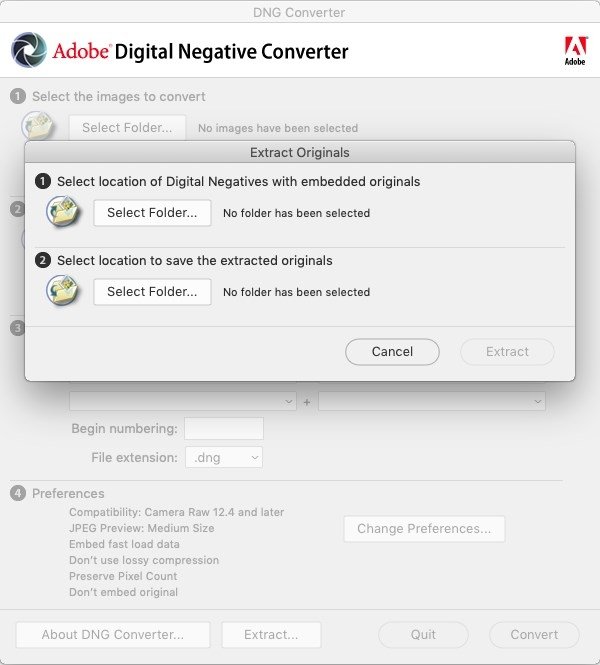
• Launch the DNG Converter by double-clicking its icon. Alternatively, drag and drop individual images or a folder of images directly onto the Adobe DNG Converter icon. This action automatically launches the converter. • Select the folder of images you'd like to convert to DNG. • Select the location where you want to save the converted DNG files. • Select a naming pattern for the new DNG files: Document Name: The existing name of the file is used with the DNG extension added. Add serial numbers or letters to the name: Advanced patterns; an example of the resulting name appears after Name Example.
Adobe Dng Converter 9.4
Adobe DNG is the utility software to convert any camera specific raw files for free. With Adobe DNG converter for mac users can open raw standard and unique files of the digital camera. For future use, this can be created with easy cataloging. Its easy availability and support have made Adobe DNG converter for mac to the people. Download Adobe DNG Converter 10.2 for Mac Free. Click on below button to start Adobe DNG Converter 10.2 Download for Mac OS X. This is completely Tested and Working Latest Version Mac OS App of Adobe DNG Converter 10.2. It is offline installer and standalone setup for Adobe DNG Converter 10.2 for Apple Macbook Macintosh. Adobe DNG Converter 10.1 For Mac Free Download. Dng converter mac Latest Version and Single Link for Mac. Vero Designer 2018 R1 is Also full offline Setup and standalone installer and Compressed Version of Adobe dng converter.
• Specify the following additional settings for the DNG file names: Begin numbering: Enter the starting serial number if you'd like it to be different from 1. File Extension: The file extension is automatically set to DNG. You can choose the extension to be either uppercase or lowercase. • If necessary, change the. • Click Convert. Adobe creative suite software for mac. A dialog box showing the status of the conversion appears. To change compatibility preferences, follow these steps: • In the Preferences section of the DNG Converter dialog box, click Change Preferences.

• Choose one of the following options: Camera Raw 2.4 and later: The DNG file will be readable by Camera Raw 2.4 (Photoshop CS) and later, and Lightroom 1.0 and later Camera Raw 4.1 and later: The DNG file will be readable by Camera Raw 4.1 (Photoshop CS3) and later, and Lightroom 1.1 and later. The DNG file will often be readable by earlier versions, depending on the camera model. Camera Raw 4.6 and later: The DNG file will be readable by Camera Raw 4.6 (Photoshop CS3) and later, and Lightroom 2.1 and later. The DNG file will often be readable by earlier versions, depending on the camera model. Camera Raw 5.4 and later: The DNG file will be readable by Camera Raw 5.4 (Photoshop CS4) and later, and Lightroom 2.4 and later.
The DNG file will often be readable by earlier versions, depending on the camera model. Camera Raw 6.6 and later: The DNG file will be readable by Camera Raw 6.6 (Photoshop CS5) and later, and Lightroom 3.6 and later. The DNG file will often be readable by earlier versions, depending on the camera model.
Adobe Dng Converter 10.1
How much is adobe suite for mac. Camera Raw 7.1 and later: The DNG file will be readable by Camera Raw 7.1 (Photoshop CS6) and later, and Lightroom 4.1 and later. The DNG file will often be readable by earlier versions, depending on the camera model.
Custom: • Backward Version: DNG 1.1, DNG 1.3, or DNG 1.4 (default 1.4) • Linear (demosaiced): The image data is stored in an interpolated (“demosaiced”) format. This option is useful if a camera’s particular mosaic pattern is not supported by a DNG reader. The default mosaic format maximizes the extent of data preserved. Mosaic image data can be converted to linear data, but the reverse is not possible. • Uncompressed: No compression is applied to the raw image data. A raw file contains the “raw” data captured by the digital camera sensor before it has been converted to JPEG or TIFF formats.
Download Adobe Dng Converter For Windows
Cameras that create JPEG or TIFF files process (and in the case of JPEG files, compress) the sensor data. When working with raw files, the file is not compressed or processed in the camera. Instead, software gives the user complete control over the conversion settings. For example, white balance is not applied to the raw file but is stored with the file so the software can default to the originally-intended setting. Other information contained in a DNG file includes standard EXIF metadata (just like in JPEG files), date, time, camera used, and camera settings.
Raw files offer the following benefits. Unlike most manufacturer-specific raw formats, the Digital Negative is an openly published specification that not only is supported by Adobe, but is also freely available for other software and hardware vendors to support. Consequently, it can be a safer file format to use for long-term archival purposes. Archiving your file as a digital negative eliminates worries that the raw file will no longer be readable once the camera format that created it becomes obsolete.